
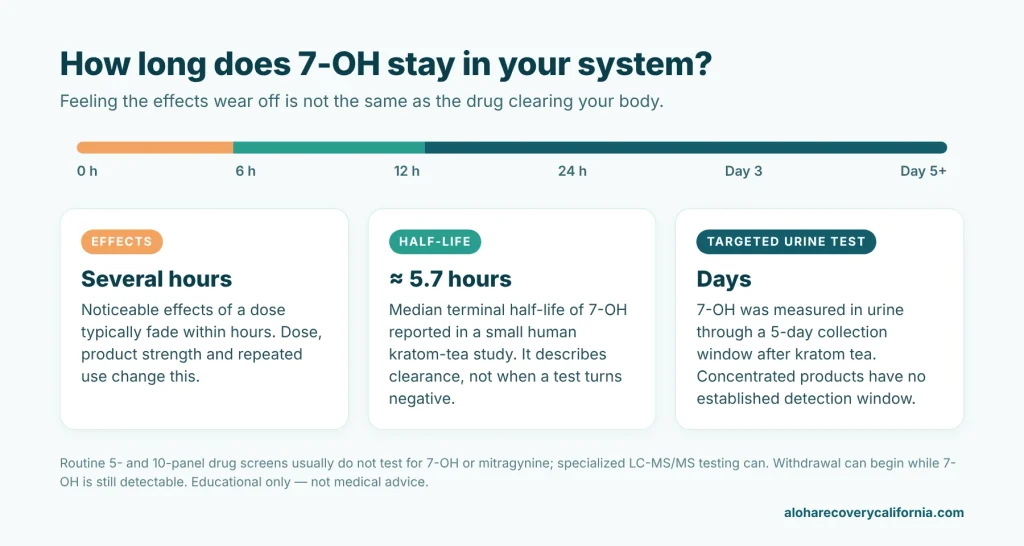
How long does 7-OH stay in your system? Targeted laboratory testing can detect 7-OH for days after exposure, while the noticeable effects of a dose usually last several hours. The exact timing depends on the product, how often you use it, and the testing method. Human kratom research offers useful findings, but concentrated 7-OH products do not have one established detection window.
This guide answers how long does 7-OH stay in your system from several angles: how long the effects last, the 7-OH half-life, how long it can be detected, whether 7-OH shows up on a drug test, and how long to wait before starting Suboxone.
If you are reading this because you are trying to stop, you can contact Aloha Recovery or call (808) 972-5642 at any time.
What is 7-OH?
7-OH, also written as 7OH, is short for 7-hydroxymitragynine. It acts on opioid receptors and occurs naturally in trace amounts in kratom. Concentrated products can contain added or enhanced levels, and the body also produces some 7-OH when it processes mitragynine, kratom’s main alkaloid.
A tablet, gummy, or shot marketed as 7-OH can therefore differ substantially from traditional kratom leaf. The FDA warns against concentrated 7-OH products, which have not been approved as safe or effective for any medical use.
How long does 7-OH last?
Reports describe 7-OH effects lasting several hours. The experience can change with the amount taken, product formulation, repeated dosing, and other substances. Research has not established a dependable onset, peak, and duration for every concentrated product.
You may notice the initial effects fading before your body has finished processing what you took. That is why feeling less sedated does not mean 7-OH has cleared, or that taking more is safe.
Repeated use adds another concern. If the next dose is increasingly about avoiding aches, anxiety, sweating, or restlessness, physical dependence may have developed. You may be organizing your day around staying comfortable rather than seeking the original effect.
For a closer look at that pattern, read our 7-OH withdrawal symptoms and timeline guide.
What is the half-life of 7-OH?
A half-life describes how long it takes a substance’s concentration in the body to fall by half. It is one measure of how the body processes a drug; it does not tell you when a test will become negative.
A small human kratom study reported a median 7-OH terminal half-life of approximately 5.7 hours. That research involved kratom tea, not concentrated tablets.
Later research on kratom leaf powder found different half-life estimates under different dosing conditions, and a 2026 study of kratom extracts found that formulation influenced exposure to kratom compounds.
The useful takeaway is that the product and pattern of use matter. A single 7-OH half-life number cannot answer how long does 7-OH stay in your system for every tablet, repeated dosing pattern, or laboratory threshold.
How long does 7-OH stay in your system? What urine testing shows
So, how long does 7-OH stay in your system once the effects are gone? Targeted urine testing can detect 7-OH for days after exposure. In the kratom-tea study, researchers measured 7-OH and other kratom alkaloids in urine collected through 120 hours, or five days, in the five participants who completed the study.
Here is what that finding does and does not establish:
| Research finding | What it means for you |
|---|---|
| 7-OH was measured in urine through a five-day collection period after kratom tea. | Detectable compounds can remain in your system for days after use. |
| The study used a sensitive research laboratory method. | A commercial test with a different threshold may produce different results. |
| Participants took kratom tea, not concentrated 7-OH tablets. | The result does not establish an exact detection window for concentrated products. |
Five days was the end of sample collection, not proof that every participant would test negative immediately afterward.
For concentrated 7-OH products, precise claims such as “one to three days after a single dose” or “seven days with daily use” go beyond what this research establishes. Your laboratory’s test and your use history are needed to interpret a result.
Does 7-OH show up on a drug test?
Yes, targeted testing can identify 7-OH. Routine drug panels may leave it out. The key question is which compounds the laboratory tests for.
Standard workplace drug panels
An opiate screen does not automatically detect every substance that acts on opioid receptors. For example, the standard DOT urine-testing panel specifies particular drugs and metabolites; 7-OH and mitragynine are not listed.
A test described as “5-panel” or “10-panel” is not enough information to establish whether kratom alkaloids are included. Employers and other organizations can order different panels or additional testing.
Specialized kratom and 7-OH testing
Laboratories offer tests for kratom alkaloids. Depending on the method, testing may screen for mitragynine, directly measure 7-hydroxymitragynine, or use a combination of screening and confirmation.
Labcorp explains that its kratom screening immunoassay targets mitragynine. It does not detect 7-OH directly, but mitragynine present in many commercial 7-OH products can produce a positive screen.
More specific laboratory methods, including liquid chromatography with tandem mass spectrometry (LC-MS/MS), can identify 7-OH when it is included in the assay.
What a negative result means
A negative result means the tested substances were not detected above that test’s reporting threshold. It does not establish that all 7-OH has left your body, and it does not answer how long does 7-OH stay in your system for your situation.
If you are seeking medical care, share what you took even when a routine drug screen is negative. A clinician also needs your symptoms, use history, and other health information.
What affects how long 7-OH stays in your system?
The label “7-OH” does not describe one standardized product or pattern of exposure. Several factors shape the answer:
- Product contents and strength. Products may contain different amounts of 7-OH, mitragynine, and other ingredients.
- Amount and frequency of use. Taking repeated doses changes exposure and makes a single-dose study less applicable.
- Metabolism and medication interactions. The body processes kratom alkaloids through pathways that can be affected by other medications and individual differences.
- Testing method. The sample type, compounds measured, and reporting threshold all affect what the laboratory finds.
Because of these variables, how long does 7-OH stay in your system is a question with a range, not a fixed number. Body weight, sweating, or the amount of water you drink cannot be turned into a reliable personal countdown. If a result needs interpretation, ask the testing provider about the specific assay.
How long after taking 7-OH can you take Suboxone?
A prescriber should determine when and how to start Suboxone after 7-OH use. A fixed waiting period cannot establish readiness for everyone.
Suboxone contains buprenorphine and naloxone. Buprenorphine can reduce opioid withdrawal and cravings, but starting it under the wrong circumstances can trigger precipitated withdrawal, a sudden worsening of withdrawal symptoms.
For standard initiation, clinicians assess withdrawal signs and symptoms, often using the Clinical Opiate Withdrawal Scale (COWS). Other initiation approaches may be appropriate in selected circumstances.
A 2026 case series involving nine people using purified 7-OH products described both standard and low-dose buprenorphine initiation. That is evidence of treatment options, not a schedule to reproduce at home.
Tell the prescriber which product you use, your usual amount, the time of your last dose, and any other opioids, alcohol, sedatives, or medications involved. If you already take prescribed buprenorphine, contact your prescriber before changing the plan.
Need help deciding where to begin? Contact Aloha Recovery to discuss assessment and 7-OH treatment options.
Can you flush 7-OH out of your system faster?
No. There is no established cleanse, supplement, exercise routine, or sauna protocol that reliably speeds 7-OH elimination or guarantees a negative test.
Hydration and nutrition can support you during withdrawal care. Their purpose is to address your needs, including fluid losses from vomiting or diarrhea; they do not prove that the substance has cleared.
If you cannot keep fluids down or symptoms are worsening, seek medical attention. Trying additional “detox” products can delay the assessment you need.
When waiting for 7-OH to wear off becomes a daily problem
Many people who search “how long does 7-OH stay in your system” are really asking whether they can get through a shift, a test, or a weekend without it. The time between doses can tell you something important about your relationship with 7-OH. Consider an assessment if you are:
- Taking another dose to avoid feeling sick.
- Needing more than you previously used.
- Worrying about running out or getting through work without it.
- Trying to cut back but repeatedly returning to use.
- Continuing despite problems with health, relationships, or responsibilities.
Physical dependence and a substance use disorder are related, but they are not interchangeable diagnoses. A clinician can help you understand what is happening and what level of support fits.
Call 911 if someone is unresponsive, breathing slowly or with difficulty, or has discolored lips. These can be signs of an overdose and require emergency help.
7-OH detox and treatment at Aloha Recovery California
If you have stopped wondering how long does 7-OH stay in your system and started wondering how to get through the day without it, you can talk about it with us without having to explain away how it started.
Aloha Recovery California provides 7-OH addiction treatment in Huntington Beach, Orange County, with medical detox and residential care. The first step is understanding your use, current symptoms, health needs, and previous attempts to stop.
Our medical detox program emphasizes clinical assessment, monitoring, comfort, and clear communication. You can ask what is happening, discuss concerns about withdrawal, and have the next steps explained.
The Aloha spirit is reflected in the daily experience of care: being greeted warmly, spoken to respectfully, and given time to ask questions. Our residential setting is designed to feel calm and welcoming. Family members can also reach out for guidance.
When continued treatment is appropriate, Aloha offers residential care with an attachment-based, trauma-informed approach and support for co-occurring mental health concerns. Care planning looks beyond the last dose to the support you will need afterward.
Call (808) 972-5642 or request insurance verification. Our admissions team can discuss your concerns, explain program options, and review potential coverage without requiring you to have every answer before you call.
FAQ: How long does 7-OH stay in your system?
Is 7-OH the same as kratom?
7-OH is one compound associated with kratom, but concentrated 7-OH products can differ substantially from traditional leaf. Tell a healthcare professional the specific product you take, and share the packaging or a label photo when possible.
How long does 7-OH stay in your urine?
Targeted testing has measured 7-OH in urine for up to five days after kratom tea in a small human study. Concentrated products, repeated dosing, and the laboratory’s threshold can all change that window, so there is no single reliable answer to how long does 7-OH stay in your system.
Can 7-OH withdrawal begin while it is still detectable?
Yes. Withdrawal symptoms and laboratory detection measure different things. A detectable amount does not necessarily prevent withdrawal, and a negative routine screen does not rule it out.
Will an at-home drug test detect 7-OH?
Check the test’s instructions and target compounds. A general home drug panel should not be assumed to detect 7-OH. Even a targeted result cannot determine whether it is appropriate to start Suboxone or whether you need medical care.
Do I need residential treatment to stop using 7-OH?
That depends on your assessment. A clinician can consider withdrawal severity, other substance use, medical and mental health needs, previous attempts to stop, and support at home. Appropriate care may involve outpatient treatment, supervised detox, residential care, or a combination.
This article is educational and does not replace individualized medical advice.